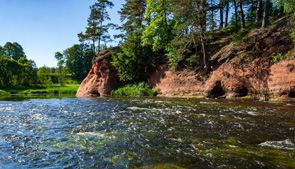
Adaptation of Water Framework Directive and Habitats Directive harmonization and integrated actions for freshwater quality improvement in Salaca River sub-catchment
The Programme for the Environment and Climate Action (LIFE)
» AREAS
Nature conservation. Management of nature territories. Governance of nature territories. Ecosystem services. Institutional capacity enhancement. Integrated environmental management. Monitoring.
» PROJECT TARGET
The aim of the project is to promote the achievement of a good water condition in the rivers of the Salaca sub-catchment, as determined by the Habitats Directive, the Water Framework Directive and the objectives of the EU Biodiversity Strategy.
» THE MAIN TASKS AND ACTIONS
-
Harmonization of the Habitats Directive and the Water Framework Directive in the model territory – Salaca River sub-catchment
- The Habitats Directive and the Water Framework Directive focus on the assessment, monitoring, pro-tection and proper management of the quality of rivers and lakes. Although there are several differences in the approach of the two directives, they have the same goal – to achieve good quality in freshwater ecosystems. In the LIFE IS SALACA project, a new approach to freshwater quality assessment and ma-nagement will be developed, combining the requirements of both directives in the Salaca River sub-cat-chment as a model territory. Based on the example of the Salacas River sub-catchment, guidelines will be prepared for the development of a unified monitoring network – a step-by-step methodical approach, so that it can be used in other river basins in Latvia as well as in other EU member states.
-
Development of the nature protection plan of the Natura 2000 territory “Salaca River Valley” in a new framework
- The Nature Park “Salaca River Valley” currently does not have a valid nature protection plan. As part of the project, it is planned to develop a new nature protection plan, incorporating the project results from the harmonization process of the Water Framework Directive and the Habitats Directive, as well as the riparian forest and fish habitat management methods implemented during the project. The resulting integrated “Sa-laca River Valley” nature protection plan will provide a comprehensive basis not only for the conservation of protected habitats and species of EU importance, but also for the implementation of Water Framework Directive measures, regulation of tourism pressure and the provision of ecosystem services, etc.
-
Develpoment of an interactive exhibition in Salacgrīva about the nature values of the Salaca River – “On the shores and depths of Salaca”
- It will consist of four complementary interactive exhibitions – river management from ancient times to the present day, a laboratory, a mini cinema and the underwater world of a river. All exhibitions are planned to be developed in popular scientific language, using various mechanical and digital devices and design solutions.
-
Improving habitat availability, quantity and quality for ecologically sensitive fish species
- In Latvia, the conservation status of the protected habitat of EU importance 3260 “Water courses of plain to montane levels with the Ranunculion fluitantis and Callitricho-Batrachion vegetation” has been asses-sed as insufficient. Excessive eutrophication and sedimentation is one of the most important factors that reduce the quality and, to some extent, the quantity of habitats for ecologically sensitive fish species. The habitat improvement guidelines prepared within project LIFE IS SALACA are expected to be adaptable for use in other Latvian salmon rivers (Gauja, Venta, Irbe, etc.) with relatively minor adjustments, thereby increasing the efficiency and benefit of similar activities.
-
Management of riparian forests
- The law on buffer zones defines the principles how to manage riparian forests in order to prevent the development of erosion processes, however, when managing river buffer zones according to the existing principles, thousands of cubic meters of sediment enter the rivers every year, which settles in rivers, inclu-ding rapids, and contributes to the deterioration of their quality. The aim of this project activity is to de-monstrate a new approach in the management of riparian forests, by optimally choosing the composition of tree species in the forest, which will positively affect and increase the diversity of vegetation in the forest.
-
Application of ecosystem service assessment in land use modeling
- The Salaca River and its tributaries provide many essential ecosystem services, for example, fish resources, freshwater quality regulation, erosion control, habitat provision, cultural services, recreational opportuni-ties, as well as aesthetic, scientific and educational value. The improved knowledge about the methods of management and restoration works applied in the Salaca River valley and the ecosystem services provided are essential to ensure the appropriate management of the Salaca River and its tributaries.
» PLANNED RESULTS
-
A new approach to freshwater quality management has been developed, combining the requirements of the Water Framework Directive and the Habitats Directive. Guidelines and recommendations supporting the Water Framework Directive and Habitats Directive harmonization process have been developed for the next cycle of the Environmental Monitoring Program.
-
A nature protection plan for the Natura 2000 territory “Salaca River Valley” has been developed, incorporating the project results and examples of good practice.
-
An interactive exhibition “On the shores and depths of the Salaca” has been created.
-
River rapids have been restored over an area of 20 ha, improving the quality of the EU-protected habitat type 3260 “Water courses of plain to montane levels with the Ranunculion fluitantis and Callitricho-Batrachion vegetation” . Good practice guidelines for implementation have been developed.
-
Riparian forests have been managed over an area of 65 ha, accompanied by the development of good practice guidelines and recommendations for amendments to regulatory acts.
-
An assessment of ecosystem services has been carried out.